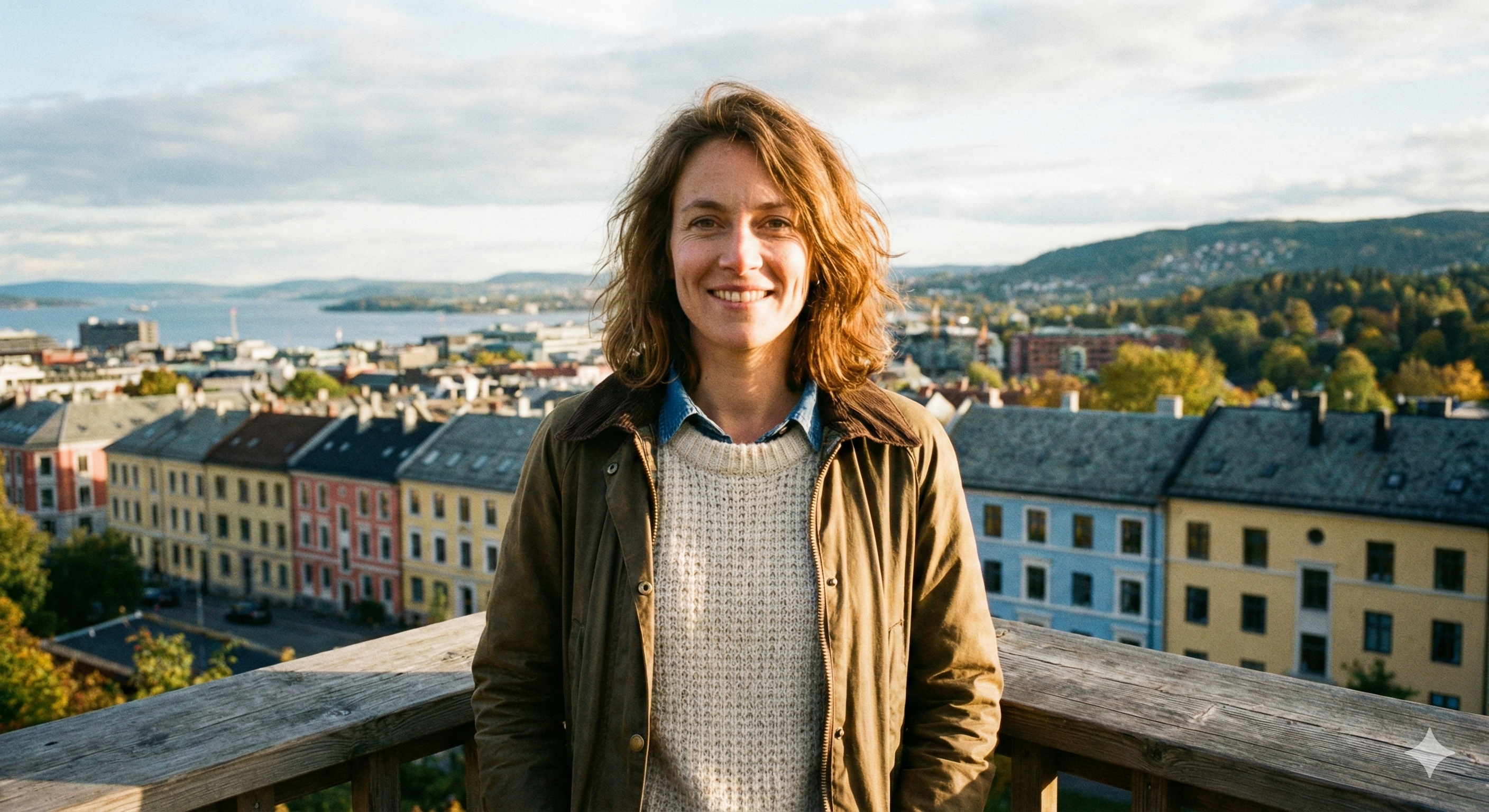
"Bergen is the Norwegian city I visit most often from Oslo. Surrounded by seven mountains and facing the sea, it has an absolutely unique charm. Every stay reminds me why so many people fall in love with this city."
— Ingrid
Why Bergen?
Bergen is Norway's second-largest city and often presents itself as Oslo's cultural rival. Nestled between the mountains and the fjords of the west coast, it offers a spectacular setting to live in. The city is known for its historic heritage, its Hanseatic wharf listed as a UNESCO World Heritage Site, and its lively music scene. Bergen is also the gateway to the country's most famous fjords, which makes it an exceptional place to live for nature lovers.
Smaller than Oslo, Bergen keeps a big-city atmosphere while remaining human in scale. You can cross the centre on foot in twenty minutes, yet it has a leading university, an international airport and a cultural life that is surprisingly rich for its size.
+ Pros
- Exceptional natural setting (fjords, mountains, sea)
- Human-scale city, easy to live in day to day
- Lower cost of living than Oslo (especially housing)
- Remarkable historic heritage (Bryggen, UNESCO)
- Very lively cultural and music scene
- Gateway to the Norwegian fjords
- Dynamic student community (University of Bergen)
- Cons
- Heavy rainfall (around 230 rainy days a year)
- Smaller job market than Oslo
- Fewer direct international flights
- Smaller expat community than Oslo
- Wet, windy winters
Where to live in Bergen?
Bergen stretches between the mountains and the sea. The city centre is compact and easy to get around on foot, but the outlying neighbourhoods offer more space and quiet. Here are the main neighbourhoods to know:
Sentrum (City centre)
The historic heart of Bergen, with Bryggen, the fish market and the station. Ideal for those who want to do everything on foot.
Sandviken
A charming neighbourhood north of the centre with its colourful wooden houses. Calm, residential atmosphere, a stone's throw from Bryggen.
Nordnes
A sought-after peninsula with views over the harbour, Bergen's aquarium and pretty lanes. A desirable neighbourhood with a relaxed atmosphere.
Fana
A residential suburb south of Bergen. Wide open spaces, good schools and easy access to hiking areas. Perfect for families.
Åsane
A large neighbourhood to the north with a shopping centre, sports grounds and more affordable housing. Well served by bus.
If you are arriving alone or as a couple, I recommend Nordnes or Sandviken: you are within walking distance of everything, in a beautiful setting. With a family, look at Fana for green spaces and schools. Also check the bus connections, as Bergen has no metro.
— IngridCost of living in Bergen
Bergen is noticeably cheaper than Oslo, especially for housing. Rents are on average 20 to 25% lower than in the capital. Food and transport prices, however, remain comparable to the rest of Norway.
| Expense | Single | Couple | Family (2 children) |
|---|---|---|---|
| Housing | 9,500 NOK | 12,000 NOK | 15,000 NOK |
| Food | 3,800 NOK | 5,500 NOK | 9,000 NOK |
| Transport | 750 NOK | 1,500 NOK | 1,500 NOK |
| Leisure | 2,500 NOK | 3,500 NOK | 4,500 NOK |
| Other | 1,800 NOK | 2,500 NOK | 3,500 NOK |
| TOTAL | ~18,350 NOK (~$1,950 / £1,450) |
~25,000 NOK (~$2,650 / £1,980) |
~33,500 NOK (~$3,550 / £2,650) |
The monthly Skyss transport pass costs around 750 NOK and covers buses and the tram (Bybanen) throughout the Bergen area. Many Bergensers also get around by bike despite the rain: it is a real local point of pride.
Working in Bergen
Bergen has a varied job market, driven by several key sectors. The city is a major economic hub on Norway's west coast and is home to the headquarters of many national and international companies.
Sectors that are hiring
- Maritime and offshore: Bergen is the heart of the Norwegian maritime industry. Companies such as DOF, Odfjell and Grieg Shipping have their headquarters here. The sector employs thousands of people in logistics, naval engineering and maritime services.
- Tech and innovation: Bergen's tech ecosystem is growing fast around Media City Bergen and the technology park. Startups in fintech, AI and marine technology emerge here every year.
- Tourism and hospitality: With more than 3 million visitors a year and fjord cruises, the tourism sector is a major employer, especially from May to September.
- University and research: The University of Bergen (UiB) and its associated research centres employ several thousand people in fields ranging from marine science to medicine.
Average salaries in Bergen
| Job | Annual gross salary |
|---|---|
| Maritime engineer | 700,000 - 950,000 NOK |
| Software developer | 650,000 - 900,000 NOK |
| University researcher | 550,000 - 750,000 NOK |
| Tour guide | 350,000 - 480,000 NOK |
| Hotel staff | 340,000 - 430,000 NOK |
Finn.no (essential), LinkedIn, NAV.no (the public employment service), Jobbnorge.no (university and public sector positions). For the maritime sector, also check Maritim Karriere.
Schools and nurseries
Bergen has a good-quality public school network, as everywhere in Norway. Education is free in public schools from year 1 to year 13 (grunnskole and videregående). A few alternatives exist for international families.
International schools
- International School of Bergen - IB (International Baccalaureate) programme, for ages 3 to 16. Located in Landås, it welcomes pupils of more than 40 nationalities.
- Storetveit skole - A public school with a reception programme for children who do not speak Norwegian, recommended for gradual integration.
Nurseries (Barnehage)
Bergen has many municipal and private nurseries. The maximum monthly fee is capped by the state (around 3,000 NOK per month). Registration is done online on the Bergen municipality website, generally in March for a start in August.
Bergen has fewer international options than Oslo, but the International School of Bergen has a very good reputation and makes it easier for foreign children to integrate. Like most international schools in Norway, it receives state support, so fees are usually far below UK or US private school fees. The free Norwegian state schools are also an excellent choice, and English-speaking children keep up their English easily: it is taught from year 1, and films and TV are in the original version.
— IngridWhat to do in Bergen?
Bergen is a city where you are never bored, even in the rain. Between historic heritage, grand nature and an intense cultural life, there is always something to discover.
Must-see sights
- Bryggen: The UNESCO-listed Hanseatic district, with its colourful wooden houses along the harbour. An emblematic place that is an absolute must-visit.
- Fløibanen: The funicular that climbs to the top of Mount Fløyen (320 m). Panoramic views of the city and the fjord, and the starting point for many hikes.
- Fjords: Excursions to the Sognefjord, the Hardangerfjord and the Nærøyfjord (UNESCO) directly from Bergen, by ferry or bus.
- Edvard Grieg Museum (Troldhaugen): The home of the famous composer, with concerts in summer in a beautiful lakeside setting.
Free activities
- Hike the seven mountains (Syvfjellsturen) that surround the city
- Walk through the Nordnes district to the aquarium
- Explore Bergen's fish market (Fisketorget)
- Wander the colourful lanes of Skuteviken
- Have a picnic at the top of Mount Ulriken in summer
Cultural life
- KODE: Bergen's art museum, spread over four buildings, with works by Munch, Klee and Picasso.
- Bergen International Festival: Every year in late May, one of the biggest music and arts festivals in Scandinavia.
- Bergenfest: An open-air music festival in June, on the harbour.
- Den Nationale Scene: Bergen's national theatre, one of the oldest in Norway.
Bergen's climate: yes, it rains a lot
Let's be frank: Bergen is the rainiest city in Norway and one of the rainiest in Europe. With around 2,250 mm of precipitation a year and more than 230 rainy days, the weather is an integral part of daily life.
But Bergensers have a saying: "There is no bad weather, only bad clothes." And it is true. The rain is often fine and intermittent, not torrential. You get used to it quickly and learn to appreciate sunny days as real gifts.
Winter is mild compared with the rest of Norway thanks to the Gulf Stream: temperatures rarely drop below -5°C. Summer is pleasant, with temperatures around 15 to 20°C and long, bright days.
Invest in a good waterproof jacket (not an umbrella, it won't survive the wind!), waterproof shoes and a good frame of mind. After a year in Bergen, you won't even notice the rain. And when the sun comes out, the whole city heads outdoors: it is magical.
— IngridInternational & English-speaking community in Bergen
Bergen's international community is smaller than Oslo's, but it is warm and active, boosted by the university, the energy and maritime sectors and research institutes. Here is how to meet other expats and English speakers:
- InterNations Bergen: The expat network has an active Bergen community with regular social events.
- Online groups: Search Facebook for "Expats in Bergen" to find groups for practical questions and meet-ups. Meetup.com also lists hiking, language-exchange and social groups.
- University of Bergen (UiB): If you or your partner study or work there, the international office and international student groups organise welcome events and social activities.
- Language cafés and clubs: The public library and the Red Cross run free language cafés (språkkafé). Joining a local sports club (idrettslag) or volunteering is the most reliable way to make Norwegian friends.
- Embassies: Most English-speaking countries (UK, US, Canada, Ireland) have their embassy in Oslo; check your government's travel site for consular services.
In Bergen even more than in Oslo, speaking Norwegian makes a real difference. The city is less used to expats than the capital, and Bergensers greatly appreciate the effort to learn their language (and their dialect, bergensk!).
Questions about Bergen?
Find my ideal city