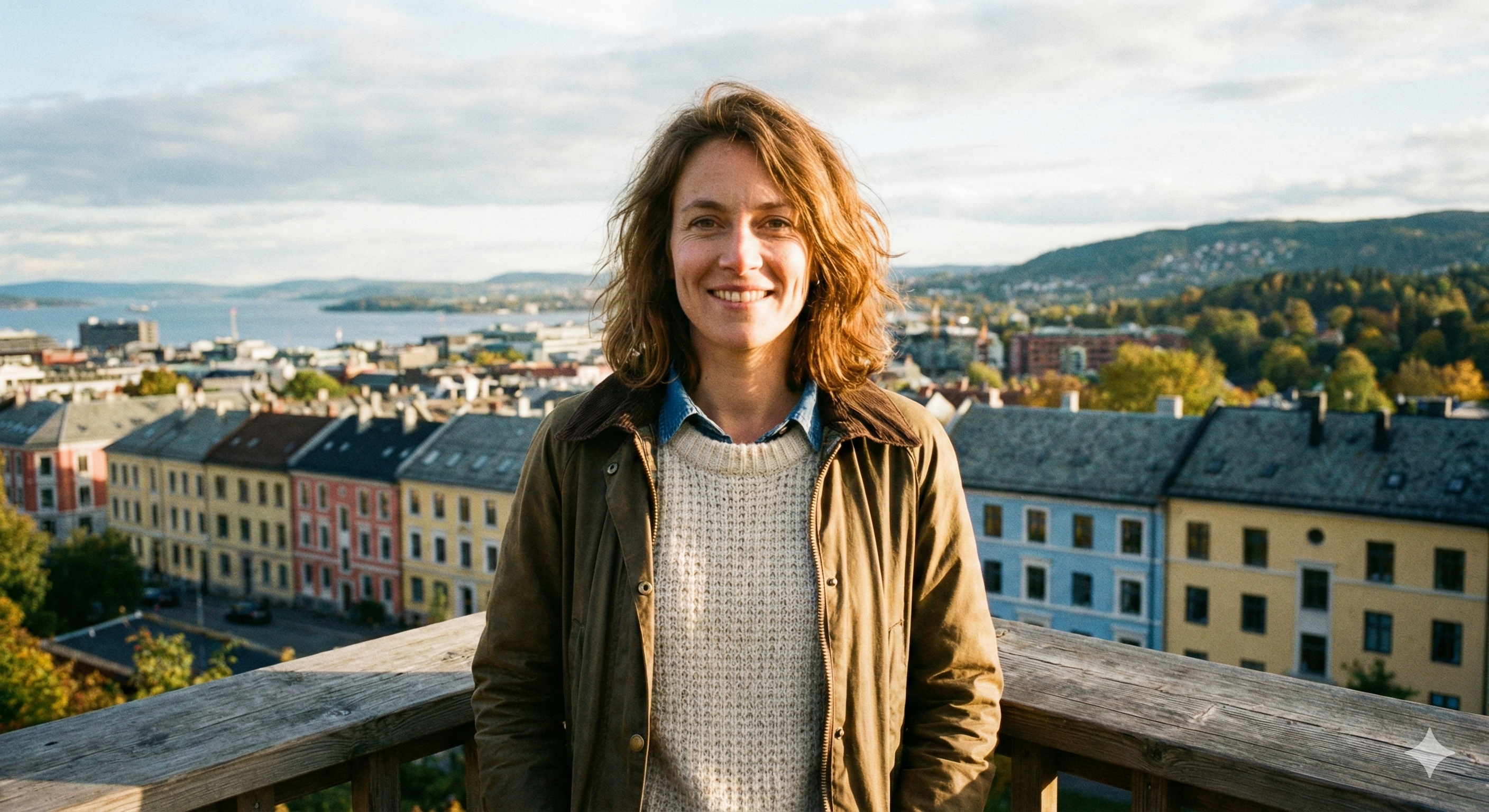
"Lillehammer is Norway's ultimate winter paradise. This small town nestled between the mountains and Lake Mjøsa hosted the 1994 Olympic Games and kept an extraordinary sporting legacy. When we visit as a family, my children are amazed by Hunderfossen, by the ski slopes reachable right from the town centre, and by the open-air museum of Maihaugen. It's a town where time slows down, where nature is queen, and where the quality of family life is simply incomparable."
— Ingrid
Why Lillehammer?
Lillehammer is a small town of 28,000 inhabitants in the Innlandet region, in the heart of inland Norway. Known worldwide for hosting the 1994 Winter Olympics, it retains a remarkable sporting and cultural legacy. Nestled at the northern end of Lake Mjøsa, Norway's largest lake, and surrounded by forested mountains, Lillehammer offers a strikingly beautiful setting to live in.
The town stands out for its charming historic centre with the pedestrian street Storgata lined with colourful wooden houses, its open-air museum Maihaugen (one of the largest in Europe), and its world-renowned ski resorts such as Hafjell and Kvitfjell. Lillehammer is also home to a NTNU campus (Norwegian University of Science and Technology), which brings a touch of university dynamism to this very human-scale town.
Living in Lillehammer means choosing a slower pace of life, centred on nature and outdoor activities. It is an ideal destination for families and mountain lovers looking for an exceptional quality of life far from the bustle of the big cities.
+ Pros
- Olympic legacy: world-class sports facilities
- Exceptional skiing at Hafjell, Kvitfjell and Sjusjøen
- Maihaugen, one of the largest open-air museums in Europe
- Family paradise with Hunderfossen and Lilleputthammer
- Charming town centre with traditional wooden houses
- Lake Mjøsa and grand nature within easy reach
- Affordable cost of living compared with the big Norwegian cities
- Rich cultural life (Norwegian Literature Festival)
- NTNU campus with an active student life
- Cons
- Very cold winters with temperatures down to -20°C
- Limited and specialised job market
- 2.5 hours from Oslo by car or train
- Very small town with little retail diversity
- Very limited nightlife
The 1994 Winter Olympics in Lillehammer are often regarded as the best Winter Games in history. The town has managed to preserve and reuse its Olympic infrastructure: the Lysgårdsbakken ski jump, the bobsleigh and luge track, and the biathlon centre are still in operation and open to the public. It is one of the rare examples of Olympic cities that have truly benefited from this legacy over the long term.
Where to live in Lillehammer?
Lillehammer is a compact town where most neighbourhoods remain accessible on foot or by bike from the centre. The town stretches along the north shore of Lake Mjøsa and climbs up into the surrounding hills. Here are the main neighbourhoods to know about for your move:
Sentrum / Storgata
The historic heart of Lillehammer, with the famous pedestrian street Storgata lined with colourful wooden houses. Shops, cafés, restaurants and galleries are all within reach. A lively and charming neighbourhood, ideal for those who want to live at the centre of the action.
Vingrom
A peaceful village on the shore of Lake Mjøsa, a few kilometres south of the centre. A bucolic setting with views of the lake and an authentic rural atmosphere. Perfect for those looking for absolute calm and proximity to the water.
Nordre Ål
A family residential neighbourhood north of the centre, well equipped with schools, nurseries and green spaces. Families enjoy the tranquillity and the proximity of hiking trails. Good bus network to the town centre.
Søre Ål
A quiet residential neighbourhood in the south of the town, with direct access to the surrounding nature. Detached houses in a green setting, halfway between the centre and the lake. Ideal for nature lovers who want to stay close to town.
Lillehammer Syd
Located in the south of the town, on the road to Hafjell. A developing neighbourhood, convenient for those who work in the tourism sector or want quick access to the ski resorts. Recent, well-equipped housing.
If you arrive alone or as a couple, the town centre around Storgata is the most pleasant place: everything is done on foot and the atmosphere is really warm. With a family, Nordre Ål is my first choice thanks to its schools and green spaces. For skiing enthusiasts who want to be on the slopes in 10 minutes, Lillehammer Syd is ideal. The rental market is much more relaxed than in Oslo: you'll easily find a place on Finn.no, even with only a month's notice. Rents are among the most affordable I have seen in Norway.
— IngridCost of living in Lillehammer
One of Lillehammer's great assets is its cost of living, significantly lower than in Norway's big cities. Rents are very reasonable, and the proximity of nature allows you to enjoy plenty of free activities. Food stays at standard Norwegian prices, but housing and leisure are noticeably cheaper than in Oslo or Bergen.
| Expense | Single | Couple | Family (2 children) |
|---|---|---|---|
| Housing | 8,000 NOK | 10,500 NOK | 13,000 NOK |
| Food | 3,500 NOK | 5,500 NOK | 8,500 NOK |
| Transport | 600 NOK | 1,200 NOK | 1,200 NOK |
| Leisure / Sport | 1,500 NOK | 2,200 NOK | 3,000 NOK |
| Heating (winter supplement) | 700 NOK | 900 NOK | 1,100 NOK |
| Other | 1,200 NOK | 1,700 NOK | 2,200 NOK |
| TOTAL | ~15,500 NOK (~$1,640 / £1,230) |
~21,000 NOK (~$2,230 / £1,660) |
~28,000 NOK (~$2,970 / £2,220) |
Public transport in Lillehammer is provided by Innlandstrafikk, with a monthly pass of about 600 NOK. However, since the town is small, many residents walk or cycle in summer. A car can be useful for reaching the ski resorts and exploring the region, especially in winter. Heating is a major expense: as Lillehammer is an inland town, winters are colder than by the sea, and electricity bills can climb significantly from November to March.
Working in Lillehammer
The job market in Lillehammer is more limited than in the big cities, but some sectors offer real opportunities. The town lives mainly on tourism, education, the public sector and culture. Speaking Norwegian is almost essential to find a job locally, as international companies are very rare in the region.
Sectors that are hiring
- Tourism and the sports industry: Lillehammer is a major tourist destination, in winter and in summer. The Hafjell and Kvitfjell ski resorts, Hunderfossen park, Maihaugen and the Olympic facilities generate many seasonal and permanent jobs: guides, ski instructors, hotel staff, event managers and tourism marketing.
- Education and research (NTNU Lillehammer): The NTNU campus in Lillehammer (formerly Høgskolen i Lillehammer) is an important employer, specialising in social sciences, film, tourism and sports management. Teaching, research and administrative positions are regularly advertised.
- Public sector: The municipality of Lillehammer and the Innlandet region employ a large number of people in administration, social services, urban planning and cultural management. As Lillehammer is a regional centre, several public bodies have their offices here.
- Culture: With the Norwegian Literature Festival (Norsk Litteraturfestival), the Maihaugen Museum, the Norwegian Olympic Museum and many cultural institutions, Lillehammer offers opportunities in the cultural and events sector.
- Healthcare: Lillehammer hospital (Lillehammer sykehus), part of Sykehuset Innlandet, regularly recruits medical and paramedical staff. European qualifications are recognised subject to language validation.
Average salaries in Lillehammer
| Job | Annual gross salary |
|---|---|
| Teacher / Researcher (NTNU) | 500,000 - 750,000 NOK |
| Nurse / Healthcare staff | 450,000 - 600,000 NOK |
| Tourism / events manager | 450,000 - 650,000 NOK |
| Ski instructor / Tour guide | 320,000 - 480,000 NOK |
| Hotel / catering staff | 310,000 - 420,000 NOK |
| Administrative employee (municipality) | 420,000 - 560,000 NOK |
If you're aiming for Lillehammer, be realistic about the job market: it is small. My best leads: check the NTNU vacancies on Jobbnorge.no, enquire with the ski resorts before the season (Hafjell recruits from September for the winter), and think about remote work. More and more Norwegians and expats live in Lillehammer while working remotely for companies in Oslo. With the train linking the two cities in 2.5 hours, some even make the trip a few days a week. The very low cost of living in Lillehammer more than makes up for the price of transport.
— IngridSchools and nurseries
Lillehammer has a good-quality public school network, typical of mid-sized Norwegian towns. Public education is entirely free, from year one to year thirteen. The town has no international school (the nearest is Gjøvik Region International School in Gjøvik, about 45 minutes away), but introductory programmes for children who don't speak Norwegian exist in the local schools.
NTNU Lillehammer
The NTNU campus in Lillehammer is a recognised university hub, offering programmes in social sciences, film and television, tourism, sports management and education. Around 5,000 students are enrolled there, which gives the town a young, dynamic energy. The campus also offers Norwegian courses for international students and Erasmus exchange programmes.
Primary and secondary schools
- Lillehammer public schools: The municipality runs several primary schools (barneskole) and lower secondary schools (ungdomsskole). Foreign children benefit from language adaptation classes (innføringsklasse) to ease their integration into the Norwegian school system.
- SFO (Skolefritidsordning): After-school care is available for children in years 1 to 4, before and after school hours. Monthly fee of about 2,400-3,000 NOK.
- Upper secondary schools (Videregående): Lillehammer Videregående Skole offers general and vocational tracks, including sports specialisations that make the most of the town's Olympic legacy.
Nurseries (Barnehage)
Lillehammer has municipal and private nurseries (barnehage). The maximum fee is capped by the state (about 3,000 NOK per month). Registration is done online via the Lillehammer kommune website, generally in March for a start in August. Places are less competitive than in Oslo, but it is still advisable to register early.
There is no international school in Lillehammer itself; if you want an English-language education, Gjøvik Region International School is about 45 minutes away. That said, Lillehammer's public schools are excellent and the small class sizes are a real plus, and English-speaking children keep up their English easily (it is taught from year 1, and TV and films are in the original version). The town's unique sporting environment also gives children access to activities you won't find anywhere else: ski jumping, biathlon, skating on Olympic facilities. My children would dream of it! It's a weighty argument for sporty families.
— IngridWhat to do in Lillehammer?
Lillehammer is a real playground for outdoor and culture lovers. The Olympic legacy, the proximity of world-renowned ski resorts, Lake Mjøsa and a cultural offering that is surprising for a town of this size make it a place to live that is rich in activities all year round.
Skiing and winter sports
- Hafjell Alpine Centre: Only 15 km from Lillehammer, Hafjell is one of the largest alpine ski resorts in Norway. Slopes used in the 1994 Olympics, varied terrain for all levels, a snow park and night skiing. Season pass at around 5,500 NOK.
- Kvitfjell: A resort about 50 km to the north, known for its Olympic downhill runs among the fastest in Scandinavia. Ideal for intermediate and advanced skiers, with spectacular panoramas.
- Sjusjøen: Cross-country skiing paradise, with more than 350 km of groomed trails across the high plateaus. One of the largest Nordic ski areas in Norway, popular with families and keen cross-country skiers.
- Olympic facilities: The Lysgårdsbakken ski jump is open to the public for visits and experiences (zip line from the top). The bobsleigh and luge track offers supervised runs open to everyone, a guaranteed adrenaline rush.
Culture and museums
- Maihaugen: One of the largest open-air museums in Europe, with more than 200 historic buildings tracing Norwegian life from the Middle Ages to today. Interactive exhibitions, traditional workshops and seasonal events. An absolute must.
- Norsk Litteraturfestival: The Norwegian Literature Festival, held every year at the end of May, attracts authors and readers from all over the country. Talks, public readings, debates and events throughout the town.
- Norwegian Olympic Museum: Located in Håkons Hall (the Olympic ice hockey arena), it traces the history of the Olympic Games and winter sports in Norway. Interactive exhibitions and memorabilia from 1994.
- Lillehammer Kunstmuseum: An art museum with a fine collection of Norwegian painting and quality temporary exhibitions.
Families and children
- Hunderfossen Eventyrpark: A family theme park 10 km from the centre, with attractions based on Norwegian tales and legends. Rides, shows, giant trolls and interactive activities. Open mainly in summer and during the Christmas holidays.
- Lilleputthammer: A theme park for young children, a miniature replica of a 19th-century Norwegian town. Children can play at being a baker, blacksmith or ship's captain. A marvel for 3-10 year olds.
- Lake Mjøsa: Swimming in summer from the developed beaches, boat trips on the Skibladner (the oldest paddle steamer still in service in the world), fishing and water activities.
Summer and outdoor activities
- Hiking and mountain biking at Sjusjøen: In summer, the Sjusjøen high plateaus turn into a network of hiking and mountain biking trails among the best in Norway. Mountain scenery, traditional cabins (hytter) and untouched nature.
- Storgata: The pedestrian street in the centre is full of independent shops, cafés and galleries. A relaxed and friendly atmosphere, particularly pleasant in summer when the terraces move outside.
- Activities on Lake Mjøsa: Kayaking, paddleboarding, sailing and fishing on Norway's largest lake. Sunsets over the lake in summer are spectacular.
If you only have one day in Lillehammer, spend it at Maihaugen. With my children, we spent a whole day there without noticing time pass. The historic houses are incredibly well preserved and the guides in period costume tell fascinating stories. In winter, the museum under snow is simply magical. And for thrill seekers, the bobsleigh run on the Olympic track is an experience you will never forget. My children still talk about it!
— IngridClimate in Lillehammer
Lillehammer has an inland continental climate, quite different from Norway's coastal towns. Located in a valley sheltered from oceanic influence, the town experiences large temperature swings between summer and winter, with four clearly distinct seasons. This is one of the reasons the town was chosen for the Olympic Games: snow conditions are reliable and plentiful.
The four seasons
- Winter (November to March): Cold and snowy, with average temperatures around -8°C in January. Lows of -20°C are not uncommon during cold snaps. Snowfall is generous and consistent, making it a paradise for winter sports. The days are short (6 hours of daylight in December) but the snow reflects the light and softens the darkness.
- Spring (April to May): The snow melts gradually and temperatures rise to between 5°C and 15°C. Spring is short but spectacular when nature bursts into green. Lake Mjøsa thaws and the first water activities resume.
- Summer (June to August): Warm and pleasant, with average temperatures around 18°C and peaks that can exceed 25°C. The days are very long (up to 20 hours of daylight in June). It is the ideal season for hiking, mountain biking, kayaking and swimming in the lake.
- Autumn (September to October): A superb period with the blazing colours of the birch and pine forests. Temperatures between 5°C and 12°C, ideal for hiking. The first snow generally arrives at the end of October or early November.
The cold in Lillehammer is dry, which makes it more bearable than you might imagine. Invest in good merino wool thermal underwear (the Norwegian brand Devold is perfect) and you'll be surprised how much you can enjoy winter. Norwegians have a saying: "Det finnes ikke dårlig vær, bare dårlige klær" (there is no bad weather, only bad clothes). In Lillehammer, that is particularly true. And frankly, a morning at -15°C with a crystal-clear blue sky and sparkling snow is so beautiful it reconciles you with the cold.
— IngridInternational & English-speaking community in Lillehammer
Lillehammer's international community is small but warm. It is mainly made up of people connected to NTNU (international students, researchers, teachers) and to the sports sector (coaches, athletes, sports federation staff). As the town is a centre of excellence in winter sports, you come across expats from all over the world who have come to train or work in sport.
- NTNU university community: The campus welcomes Erasmus students and international researchers every year. Student associations regularly organise intercultural events, parties and excursions.
- International sports community: Lillehammer attracts athletes and sports professionals from all over the world. Norwegian sports federations hold training camps and international competitions there all year round.
- Remote-working expats: A growing number of families and young professionals choose Lillehammer for its quality of life while working remotely. This trend is slowly strengthening the small town's diversity.
- Online groups and embassies: Search Facebook for "Expats in Lillehammer" or "Expats in Innlandet" to find local groups. Most English-speaking countries (UK, US, Canada, Ireland) have their embassy in Oslo; check your government's travel site for consular services.
- Local integration: Lillehammer's small size makes it easier to meet people. Norwegians are reserved at first, but sports clubs (skiing, skating, football), volunteering and cultural events are excellent routes to integration.
In Lillehammer, the key to integration is sport and nature. Sign up for a ski or hiking club: you'll immediately meet passionate and welcoming locals. The dugnad (community volunteer work days) are also a very strong tradition in small Norwegian towns. Helping maintain the local stadium or prepare a festival will open priceless doors. And of course, learn Norwegian: in a town of this size, it is absolutely essential. The municipal library often offers free language cafés.
— IngridThe municipality of Lillehammer offers a welcome programme for newcomers, with information sessions on municipal services, school registration and administrative procedures. Contact Lillehammer kommune as soon as you move. Norwegian courses for adults are run by the Lillehammer Læringssenter, with intensive and evening formats suited to working people.
Questions about Lillehammer?
Find my ideal city