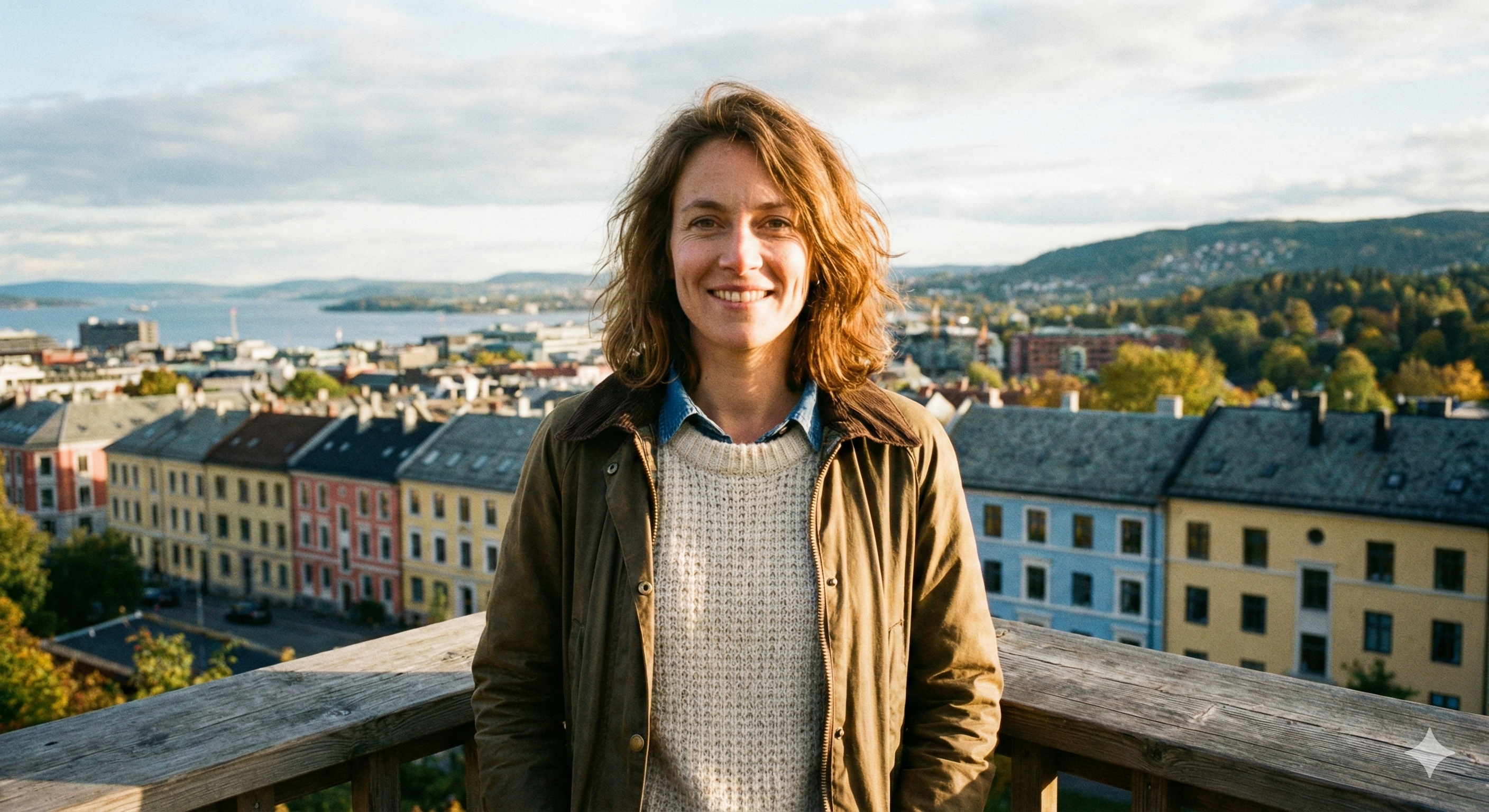
"Moss is one of those Norwegian towns that doesn't look like much at first glance, but reveals an incredibly rich soul when you take the time to discover it. It was while visiting Jeløya on a sunny Sunday that I understood why so many artists have made their home there. The island is a real jewel box of nature and culture, with the F15 gallery perched facing the fjord. Just an hour from Oslo by train, Moss offers an affordable, creative and peaceful setting, perfect for families like ours who want room to breathe without cutting the link with the capital."
— Ingrid
Why Moss?
Moss is a town of 50,000 inhabitants on the eastern shore of the Oslofjord, in the former region of Østfold (now part of Viken). With a significant industrial past, Moss has gradually turned into a recognised cultural and artistic hub, while keeping an authentic and accessible character. Its position about an hour by train from Oslo makes it a smart choice for those who want to be close to the capital without paying capital prices.
Moss's identity is deeply tied to art and creation. The town hosts the Momentum contemporary art biennial, one of the most important in Scandinavia, and the island of Jeløya is home to the famous Galleri F15 in an exceptional natural setting. This artistic vocation attracts a growing creative community that helps renew the town's image, with artists' studios, independent galleries and cultural events throughout the year.
Moss also has strong historical roots: the Convention of Moss was signed here in 1814, a founding act in the history of Norwegian independence. The town also has a direct link to Vestfold thanks to the Moss-Horten ferry, opening the way to the western side of the fjord. Between art, history, nature and accessibility, Moss is increasingly appealing to families and young professionals looking for a different way of life.
+ Pros
- Lively arts and cultural scene (Momentum, Galleri F15)
- Only 1 hour from Oslo by train (regular services)
- Housing noticeably more affordable than in Oslo
- Island of Jeløya: unspoilt nature, beaches and art galleries
- Ferry connection to Horten and Vestfold
- Fast-growing creative community
- Pleasant setting for families with children
- Cons
- Industrial heritage still visible in some neighbourhoods
- Smaller local job market
- Commuter-town feel during the week
- Relatively quiet nightlife
- Some parts of the centre still need renewal
Where to live in Moss?
Moss stretches along the Oslofjord, with a compact town centre and residential neighbourhoods running inland and towards the island of Jeløya to the south. The town is crossed by the Mosseelva river and bordered by the Moss canal. Which neighbourhood to choose depends on your priorities: closeness to the station for commuters, the natural and artistic setting of Jeløya, or family quiet in the residential areas. Here are the five main neighbourhoods to consider:
Sentrum (City centre)
The heart of Moss, with its shopping streets, cafés, the library and most administrative services. The town centre is compact and easy to get around on foot. It has a mix of renovated older buildings and newer constructions. The station is a few minutes' walk away, making it the ideal neighbourhood for Oslo commuters. Neighbourhood life is lively, with regular markets and a friendly atmosphere.
Jeløy
The island of Jeløya is the jewel of Moss. Linked to the mainland by a bridge, it offers an exceptional setting of forests, pebble beaches, walking trails and the famous Galleri F15. The neighbourhood is prized for its large properties, historic villas and peaceful atmosphere. Jeløy attracts artists, well-off families and nature lovers. Prices are higher than in the rest of Moss, but the setting is incomparable.
Kambo
Located north of Moss, Kambo has its own railway station on the Oslo-Moss line, which makes it a strategic choice for commuters. The neighbourhood is residential, quiet and well served. You'll find detached houses with gardens, small apartment blocks and a village feel. Families appreciate the closeness of the forest and the local schools. Prices remain very reasonable for the region.
Melløs
A family residential neighbourhood east of the town centre, Melløs is appreciated for its calm, green spaces and good schools. It mainly offers detached houses and small apartment buildings in a leafy environment. Local shops are within reach, and the town centre is a few minutes away by bike. It is one of the most affordable neighbourhoods in Moss, ideal for a first purchase.
Mosseporten
A modern commercial area in the north-east of Moss, Mosseporten is home to the town's main shopping centre and a variety of shops and services. The residential neighbourhood around it is fairly recent, with modern, well-equipped homes. The E6 motorway is right there, which suits those who get around by car. The neighbourhood lacks a little pedestrian charm but offers undeniable practical comfort.
If you commute to Oslo every day, Sentrum or Kambo are your best allies thanks to the nearby stations. Kambo is particularly clever: it is one stop before Moss, so you board a train that is often less crowded. For families who put quality of life first, Jeløya is a dream, but prepare a larger budget. My personal favourite remains Melløs: quiet, green, affordable, with good schools and the centre five minutes away by bike. It is the ideal compromise to start with.
— IngridCost of living in Moss
Moss has a noticeably lower cost of living than Oslo, especially for housing. Expect to save around 25 to 35% on rent compared with the capital. Food prices are comparable to the rest of Norway, and local transport remains affordable. If you commute to Oslo, though, you will need to add the cost of the monthly train pass, which is a significant item.
| Expense | Single | Couple | Family (2 children) |
|---|---|---|---|
| Housing | 8,000 NOK | 10,500 NOK | 13,500 NOK |
| Food | 3,500 NOK | 5,500 NOK | 8,000 NOK |
| Transport (local + train to Oslo) | 2,000 NOK | 2,800 NOK | 3,000 NOK |
| Leisure | 1,500 NOK | 2,200 NOK | 3,000 NOK |
| Other (phone, internet, insurance) | 1,500 NOK | 1,800 NOK | 2,200 NOK |
| TOTAL | ~16,500 NOK (~$1,750 / £1,310) |
~22,800 NOK (~$2,420 / £1,810) |
~29,700 NOK (~$3,150 / £2,350) |
The monthly Vy pass for the Moss-Oslo journey costs about 3,100 NOK. If you take the train from Kambo, the fare is slightly lower because the zone is closer to Oslo. Some employers offer partial or full reimbursement of the travel pass: this is something to negotiate when you are hired. The Moss-Horten ferry (Bastø Fosen) costs about 100 NOK per crossing for a foot passenger, which also opens up work or leisure possibilities in Vestfold.
For groceries, the Kiwi and Rema 1000 supermarkets in Moss offer the best everyday prices. Moss market (Moss Torv) is also a good place to find fresh local produce. If you have a car, a trip to Sweden for bulk shopping is an option: the border is only 45 minutes away. My husband and I do it about once a month, and the savings on dairy, meat and drinks are real.
— IngridWorking in Moss
Moss's local job market is smaller than that of Norway's big cities, but the town offers opportunities in several growing sectors. Many Moss residents work in Oslo and commute daily, taking advantage of the direct rail link. The town is, however, developing its own economic fabric, notably in the creative industries and the public sector.
Sectors that are hiring
- Creative industries: Moss's artistic vocation translates into a developing creative ecosystem. Galleries, artists' studios, design and communication agencies, photography and audiovisual studios: the cultural and creative sector creates jobs and attracts talent. The Momentum biennial and regular cultural events also generate significant event-related activity.
- Industry and production: Moss retains an industrial fabric inherited from its past, with companies in food processing, packaging (Peterson Packaging has its roots here), chemicals and materials. These companies recruit engineers, technicians and skilled operators.
- Public sector: The municipality of Moss, schools, healthcare facilities and social services are major employers. Positions in administration, teaching, early childhood and care are regularly open.
- Commuting to Oslo: A significant number of Moss residents work in Oslo in every sector (IT, finance, consulting, healthcare, engineering). The one-hour train journey is considered acceptable by most commuters, and partial remote working makes this lifestyle even more viable.
- Retail and services: The Mosseporten shopping centre, town-centre shops and the catering sector offer jobs in sales, logistics and hospitality, especially in the peak tourist season.
Average salaries in Moss
| Job | Annual gross salary |
|---|---|
| Designer / Graphic designer | 450,000 - 600,000 NOK |
| Industrial engineer | 550,000 - 750,000 NOK |
| Teacher | 470,000 - 590,000 NOK |
| Healthcare staff (nurse) | 490,000 - 610,000 NOK |
| Sales assistant / Retail | 380,000 - 480,000 NOK |
| Administrative staff | 410,000 - 540,000 NOK |
Finn.no (unavoidable in Norway), LinkedIn, NAV.no (the public employment service), Jobbnorge.no (public-sector and university jobs). For local listings, also check the website of the municipality of Moss (moss.kommune.no). If you're aiming for a job in Oslo, remember to state in your applications that you are based in Moss and willing to commute: it's a lifestyle Norwegian employers understand perfectly.
If you work in a creative field, Moss is a stimulating environment and far more affordable than Oslo for starting a business. I have met several foreign artists and designers who settled here for precisely that reason: studio rents are reasonable, the creative community is close-knit and the exhibition opportunities are real. For employees, the Moss-Oslo combination works very well: an hour on the train is the time to read a book or answer your emails. My husband knows colleagues who have done this commute for years without tiring of it.
— IngridSchools and nurseries
Moss has a solid public school network, with around ten primary schools (barneskole) and several lower secondary schools (ungdomsskole). Norwegian public education is free and of good quality. The town also has enough municipal and private nurseries for families with young children.
Schools and education options
- Moss public schools: The municipality's public schools follow the Norwegian national curriculum. Children who don't speak Norwegian receive extra Norwegian lessons (særskilt norskopplæring) to help them integrate. Moss schools are generally small, which allows pupils to be followed individually.
- Jeløy skole: Jeløya's school is particularly appreciated for its natural setting and active teaching methods. Children regularly make use of the island's outdoor environment for outdoor learning activities.
- Moss videregående skole: Moss's upper secondary school (videregående skole) offers several tracks, both general and vocational, covering the needs of teenagers up to age 19.
- CIS Moss: Moss has its own English-language international school, CIS Moss. Like most international schools in Norway it is a fee-paying private school receiving state support, so fees are usually far below UK or US private-school fees. Check the school's website for current programmes, age range and fees.
- Oslo-area international schools: For more choice, the Oslo area (Oslo International School, British School of Oslo, Northern Lights International School, Asker International School) is reachable by train.
- Høgskolen i Østfold: The Østfold university college has a campus in Halden and another in Fredrikstad, both reachable from Moss, with programmes in engineering, computer science, health and social sciences.
Nurseries (Barnehage)
Moss has many municipal and private nurseries (barnehager). The monthly fee is capped nationally at around 3,000 NOK for a full-time place. Registration is done through the municipality's online portal, generally in March for a start in August. Moss nurseries put the emphasis on outdoor activities, in line with the Norwegian tradition of friluftsliv (outdoor life). Several barnehager are located close to the forest or the shoreline, offering an ideal setting for children's development.
Moss schools are welcoming and human-sized. My expat friends living there are unanimous: children integrate quickly, thanks in particular to the small classes and the attention teachers give. For English-speaking families, keeping up English is rarely a problem: it is taught from the first year of school and films and TV are shown in their original version. And honestly, children pick up Norwegian at lightning speed through immersion. My daughter had a classmate in Oslo who moved to Moss: within six months he was speaking fluently and had made a solid group of friends.
— IngridWhat to do in Moss?
Moss offers a cultural and natural richness that is surprising for a town of its size. Art is everywhere, nature is within reach, and history is told on every street corner. Here are the must-sees and the local gems.
Art and culture
- Galleri F15 (Jeløya): Housed in a historic manor facing the fjord, Galleri F15 is one of Norway's most renowned contemporary art spaces. Exhibitions change regularly and mix Norwegian and international artists. The setting, between sculpture garden and water views, is a reason to visit in itself. The museum café is a popular meeting place for locals.
- Momentum - Nordic Biennial of Contemporary Art: Held every two years in Moss, Momentum turns the town into one huge exhibition space. Artists from around the world take over unusual venues: former factories, warehouses, public spaces. The event attracts thousands of visitors and puts Moss on the international contemporary art map.
- Moss by Brewing: A craft microbrewery set in a former industrial building, Moss by Brewing has become an essential gathering place. You can taste local beers in a relaxed atmosphere, with regular cultural events (acoustic concerts, quiz nights, exhibitions). The place perfectly embodies the town's creative reinvention.
- Konventionsgården (Convention of Moss, 1814): This historic building is where the Convention of Moss was signed on 14 August 1814, a fundamental act in the building of modern Norway. The site can be visited and offers a fascinating insight into the history of Norwegian independence. A cultural stop not to be missed.
Nature and outdoors
- Jeløya trails: The island offers a network of hiking and walking trails winding through forests, meadows and shoreline. The pebble beaches and coves are reachable on foot, and walking around the island is a classic Sunday outing for Moss families. In summer, swimming in the fjord is a simple, refreshing pleasure.
- Lake Vansjø: A few kilometres east of Moss, Lake Vansjø is the largest lake in Østfold. It offers swimming, fishing, canoeing and hiking along its banks. The equipped picnic areas make it an ideal family outing in summer.
- Verdens Ende (nearby): Reached by the Moss-Horten ferry followed by a short drive, Verdens Ende ("the end of the world") is a spectacular natural site at the southern tip of the island of Tjøme. The rocks sculpted by the sea and the lighthouse make for a grand landscape. It is a perfect day trip from Moss.
- Fishing and water activities: The Oslofjord offers excellent conditions for fishing, kayaking and sailing. Moss marina is busy in summer, and several water-sports clubs welcome beginners and experienced sailors alike.
Local life and food
- Moss Torv: Moss's central market is a place for daily life and meeting people. Fresh produce, local crafts and a friendly atmosphere make it a regular rendezvous for residents.
- Restaurants and cafés in the centre: Moss town centre offers a varied choice of places to eat, from cosy cafés to seafood restaurants. The local food scene benefits from the nearby fjord and fresh produce from the sea.
- Moss-Horten ferry: The ferry crossing of the fjord (about 30 minutes) is an activity in itself, with magnificent views over the Oslofjord. It is also a gateway to Vestfold and its attractions (Tønsberg, Sandefjord, Verdens Ende).
My favourite place in Moss is without hesitation Jeløya on a Sunday morning. You park at the start of the island, walk around it, stop at Galleri F15 for an exhibition and a coffee facing the fjord, then head down to a little beach so the children can throw stones into the water. It is simple, it is beautiful, and it recharges you for the whole week. Another favourite: take the ferry to Horten and carry on to Verdens Ende with a picnic. The landscape at the tip of Tjøme is unforgettable, especially in clear weather. And don't forget Moss by Brewing on a Friday evening: the atmosphere is warm and it's easy to make friends there.
— IngridThe climate in Moss
Moss enjoys a continental climate tempered by the coastal influence of the Oslofjord. The seasons are clearly marked, with cold winters that are generally less harsh than in the interior of the country, and pleasant, bright summers. The nearby fjord slightly softens temperature extremes and brings a certain humidity.
Winters (December to February) see average temperatures around -4°C, with regular snowfall and periods of frost. The fjord rarely freezes completely, but the snowy landscapes along the shoreline are superb. Summers (June to August) are pleasant, with average temperatures around 18 to 20°C and occasional peaks above 25°C. The long summer days (up to 18 hours of daylight in June) let you make the most of nature and outdoor activities.
Spring arrives gradually in April-May with blossom and the return of greenery, while autumn (September-October) brings beautiful colours to the forests of Jeløya and the surrounding area. Precipitation is moderate (about 800 mm a year), well spread through the year, with a slight autumn peak. Daylight varies strongly with the seasons: expect about 6 hours of light in December against 18 hours in June.
Moss's climate is perfectly bearable for newcomers from milder countries. Winter is cold, certainly, but dry and often sunny, which is much more pleasant than the damp cold you may know back home. Summer is a real treat, especially on Jeløya where you can swim in the fjord from the end of June. My advice: invest in a good winter coat, quality waterproof shoes and a light therapy lamp for the dark months of November-December. After seven Norwegian winters, I can assure you that you get used to it, and the first snow is always a magical moment, especially for children.
— IngridInternational community in Moss
Moss's international community is modest compared with Oslo or Bergen, but it exists and benefits greatly from the closeness of the capital. Expats living in Moss often have access to the networks and events of Oslo's international community, while enjoying a calmer and more affordable everyday setting.
- Facebook and online groups: Search Facebook for "Expats in Moss" or "Expats in Norway": national and regional expat groups are active and quick to answer practical questions, and some members live in Moss and the Østfold region.
- Oslo's international networks: InterNations and the many Meetup.com groups in Oslo are an hour away by train, and are a good way to meet other English speakers.
- Language cafés: Public libraries and the Red Cross run free language cafés (språkkafé) where newcomers practise Norwegian with volunteers. It's an excellent way to meet both expats and Norwegians.
- Norwegian classes: The municipality of Moss offers Norwegian courses for newcomers through the introduction programme (introduksjonsprogrammet). Learning the language is the key to integration, and the local courses are of good quality with human-sized groups.
- Local associations: Sports clubs (idrettslag), cultural associations and volunteer groups are excellent ways to integrate in Moss. Football, handball and outdoor activities let you build ties with Norwegians quickly.
Moss's advantage over a big city is its human scale. People recognise each other, parents run into one another at school, and ties form naturally. The people of Moss are known for being welcoming, no doubt also because the town has a long tradition of openness linked to its port and its international industrial history. Learning Norwegian remains essential, but English is widely spoken in the meantime.
What I like about small towns like Moss is that you're not just a number. My friends who live there integrated faster than in Oslo, precisely because everything is more accessible: teachers know the parents, neighbours talk to each other, and local activities create real communities. Moss's art scene also attracts open-minded, curious people, which makes meeting people easier. And when you feel the need for a big city, Oslo is an hour away by train. It really is the best of both worlds.
— IngridQuestions about Moss?
Find my ideal city