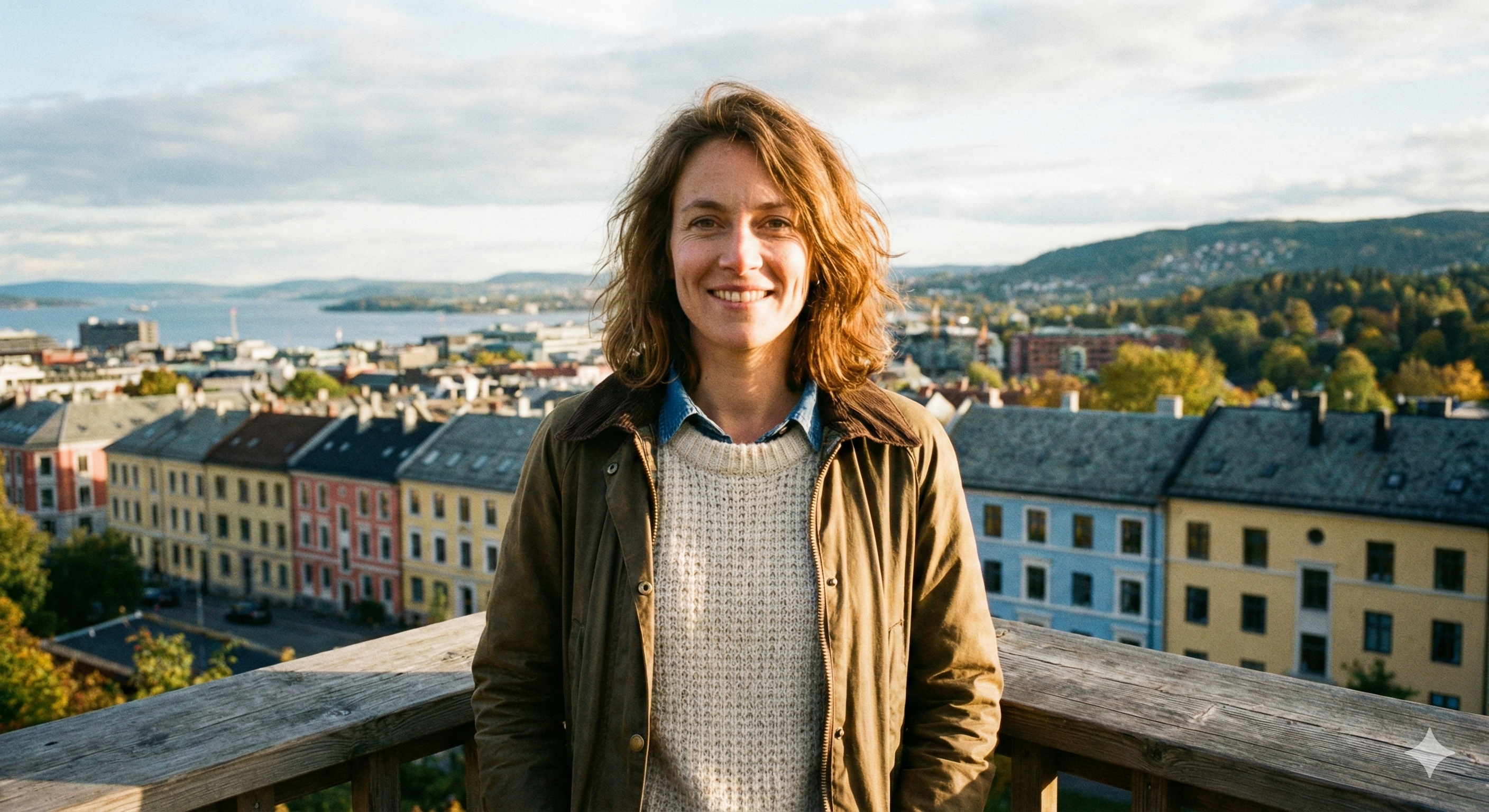
"Skien is a town that touched me from my very first visit. You walk in the footsteps of Henrik Ibsen, the greatest Scandinavian playwright, while enjoying a soothingly simple way of life. The Telemark Canal, the endless forests, the unbeatable prices... Skien embodies an authentic Norway, far from the bustle of the big cities. For those looking for tranquillity and a truly reasonable cost of living, it's a remarkable choice."
— Ingrid
Why Skien?
Skien is a town of 55,000 inhabitants, the capital of Telemark county, about 130 kilometres south-west of Oslo. Known worldwide as the birthplace of Henrik Ibsen, the father of modern theatre, Skien is a town steeped in history and culture. But beyond its literary heritage, it is a town where daily life unfolds at a calm pace, in an exceptional natural setting.
Telemark is a legendary region in Norway. It is where telemark skiing was born, the original form of modern skiing, and the region has remained deeply attached to its traditions. Skien is its gateway, with the famous Telemark Canal linking the town to the interior over more than 100 kilometres. The town has a rich industrial heritage, gradually turned into cultural and leisure spaces.
One of Skien's major assets is its cost of living: it is one of the most affordable towns in Norway. Rents are much lower than in Oslo, Bergen or Stavanger, making it a smart choice for families and people who want to live comfortably without an astronomical salary. The University of South-Eastern Norway (USN) has a dynamic campus here, and the town offers a genuinely Norwegian quality of life.
+ Pros
- One of the most affordable towns in Norway (rents and everyday life)
- Henrik Ibsen's hometown, rich cultural heritage
- Exceptional Telemark nature (forests, lakes, mountains)
- Telemark Canal, a historic and tourist gem
- USN university campus with varied programmes
- Ideal town for families (calm, safety, green spaces)
- Genuinely Norwegian way of life, far from mass tourism
- Birthplace of telemark skiing, a winter-sports paradise
- Cons
- Limited job market, especially in the private sector
- About 2h30 from Oslo by car or train
- Can feel isolated for those used to big cities
- Long, cold winters with little light
- Less cosmopolitan atmosphere than the big cities
- Limited choice of restaurants and nightlife
Where to live in Skien?
Skien is a compact town that is easy to get to grips with. The town centre is organised around the Porsgrunn river and the Telemark Canal, while the residential neighbourhoods spread into the surrounding hills and wooded areas. Which neighbourhood to choose depends mostly on your lifestyle: closeness to the centre, budget, need for space or direct access to nature. Here are the five main neighbourhoods to consider:
Sentrum (City centre)
The heart of Skien, with its shopping streets, cafés, the Ibsenhuset (cultural centre) and direct access to the Telemark Canal. Sentrum concentrates most of the town's services, shops and restaurants. It has a mix of renovated older buildings and recent constructions. The neighbourhood is ideal for those who want everything on foot: station, library, market and waterfront. Housing is mainly medium-sized apartments.
Gulset
A large residential neighbourhood east of the town centre, Gulset is one of the most affordable areas of Skien. It mainly has apartment buildings and small detached houses. The neighbourhood has its own shopping centre, several schools and sports facilities. Access to nature is immediate, with forest trails starting right from the neighbourhood. Gulset is a pragmatic choice for small budgets.
Falkum
A residential neighbourhood popular with families, south of the town centre. Falkum offers a green, quiet setting, with lovely detached houses and spacious gardens. The proximity of several primary schools and a lower secondary school makes it a natural choice for parents. The neighbourhood is well served by buses and remains a few minutes from the centre by car or bike. The atmosphere is peaceful, typical of Norwegian neighbourhood life.
Klyve
A multicultural neighbourhood and the most affordable in Skien, Klyve lies north-east of the centre. It's a lively area, with a diverse population and international shops. The neighbourhood has an active community centre, schools and green spaces. Rents are the lowest in town, making it an accessible entry point for newcomers. Klyve is undergoing urban renewal, with new developments planned.
Borgestad
Located between Skien and Porsgrunn, Borgestad is a quiet, green neighbourhood surrounded by nature. A former industrial site, the area has been converted into a pleasant residential zone. You'll find detached houses with gardens, easy access to hiking trails and a countryside feel while staying close to urban amenities. Borgestad suits perfectly those who are looking for absolute calm and space.
For a first stay in Skien, I recommend starting with Sentrum or Falkum. The town centre lets you discover the town on foot and find your bearings easily, while Falkum is perfect if you have children and want a quiet neighbourhood with good schools nearby. Rents are so low compared with Oslo that you'll be pleasantly surprised: you can find a decent three-room flat for 9,000 NOK in the centre. Check Finn.no and local Facebook groups for listings.
— IngridCost of living in Skien
Skien is one of the most affordable towns in Norway, and that is a weighty argument for expats. Housing is where the savings are most spectacular: rents are about 40 to 50% lower than in Oslo and 20 to 30% lower than in Bergen or Stavanger. Food prices remain similar to the rest of Norway (supermarkets apply national prices), but spending on leisure, eating out and services is generally lower than in the big cities.
Transport is inexpensive because the town is compact and easy to get around by bike or bus. If you need to go to Oslo regularly, the train journey takes about 2h30, which makes a daily commute unrealistic, but occasional trips remain perfectly manageable.
| Expense | Single | Couple | Family (2 children) |
|---|---|---|---|
| Housing | 7,500 NOK | 9,500 NOK | 12,000 NOK |
| Food | 3,200 NOK | 5,000 NOK | 8,000 NOK |
| Transport | 800 NOK | 1,200 NOK | 1,500 NOK |
| Leisure | 1,500 NOK | 2,300 NOK | 3,000 NOK |
| Other (phone, internet, insurance) | 2,000 NOK | 2,000 NOK | 2,500 NOK |
| TOTAL | ~15,000 NOK (~$1,590 / £1,190) |
~20,000 NOK (~$2,120 / £1,580) |
~27,000 NOK (~$2,860 / £2,140) |
The monthly bus pass for the Skien area (Farte) costs about 750 NOK for an adult. As the town is fairly compact, many residents cycle daily from spring to autumn, which cuts transport costs even further. If you have a car, note that parking in the town centre is affordable compared with Norway's big cities.
What struck me in Skien is that you can genuinely live comfortably on a modest budget. The Kiwi, Rema 1000 and Extra supermarkets are well established and offer competitive prices. For families, the cost of children's activities is very reasonable: local sports clubs, ski lessons and municipal activities are far cheaper than in Oslo. A friend of mine who moved to Skien from a big European capital always tells me he feels like he's "living like a king" compared with his old big-city budget.
— IngridWorking in Skien
The job market in Skien is smaller than in Norway's big cities, but it offers real opportunities in several sectors. The town is the administrative centre of Telemark, which generates many public-sector jobs. The University of South-Eastern Norway (USN), Telemark Hospital and local administrations are the main employers. The private sector is present through industry, retail and services.
It is important to note that Skien is not suited to those looking for a very dynamic and diverse job market. If you work in tech, finance or consulting, opportunities will be limited. On the other hand, for professionals in healthcare, education, the public sector or industry, Skien offers an exceptional way of life with a very favourable salary-to-cost-of-living ratio.
Sectors that are hiring
- Public sector and administration: Skien is the seat of Telemark's administration. The municipality, the fylkeskommune (county authority) and state services (NAV, Skatteetaten, etc.) employ a significant share of the working population. Administrative, legal and management positions are regularly advertised.
- Education and research (USN): The University of South-Eastern Norway has an active campus in Skien with programmes in humanities, education, economics and technology. The university recruits teachers, researchers and administrative staff. The municipality's primary and secondary schools also hire teachers.
- Healthcare: Sykehuset Telemark (Telemark Hospital) is one of the largest employers in the region. It constantly recruits nurses, doctors, care assistants and allied health professionals. Care homes and home-care services are also in demand.
- Industry: Telemark has a long industrial tradition. Skien and its surroundings host companies in chemicals, energy, food processing and engineering. Local industry, though less dominant than it once was, continues to offer skilled jobs.
- Retail and services: Shopping centres, local shops, seasonal hospitality (linked to canal and Ibsen tourism) and catering offer accessible jobs, especially for newcomers.
Average salaries in Skien
| Job | Annual gross salary |
|---|---|
| Nurse | 480,000 - 600,000 NOK |
| Teacher | 470,000 - 580,000 NOK |
| Public administrator | 450,000 - 600,000 NOK |
| Industrial technician | 420,000 - 560,000 NOK |
| Healthcare staff (care assistant) | 380,000 - 480,000 NOK |
| Retail / sales | 350,000 - 450,000 NOK |
Finn.no remains essential for all job offers in Norway. Also check NAV.no (the public employment service), Jobbnorge.no (university and public-sector posts) and the website of Skien municipality for municipal jobs. For the hospital, go directly to the Sykehuset Telemark website. Word of mouth works very well in a town of this size.
Let's be honest: if you work in a very specialised or international field, Skien probably won't be your first choice. But if you work in healthcare, education or the public sector, you'll find an excellent balance between quality of life and career opportunities. Salaries are slightly lower than in Oslo, but the cost of living is so much lower that your real purchasing power will often be higher. Remote working has also changed the game: several expats I know work for Oslo-based companies from Skien.
— IngridSchools and nurseries
Skien has a solid public school network, typical of Norwegian towns of this size. Education is free from year 1 to year 13 in the public system. The town has around fifteen primary schools (barneskole), several lower secondary schools (ungdomsskole) and upper secondary schools (videregående skole). The University of South-Eastern Norway (USN) brings an attractive higher-education hub to the town.
School system
- Public primary and lower secondary schools: Skien's public schools offer quality education in a caring environment. Children who don't speak Norwegian receive extra Norwegian lessons (særskilt norskopplæring) to help them settle in. The human scale of the schools allows for the individual attention you rarely find in big cities.
- Upper secondary schools (Videregående): Skien has several upper secondary schools offering general and vocational tracks. Skien videregående skole is the main one, with a varied range of specialisations.
- University of South-Eastern Norway (USN): The Skien campus offers programmes in humanities, education, economics, IT and health. Some programmes are taught in English, which attracts international students. The university gives the town a young, dynamic atmosphere.
- International School Telemark: There is no international school in Skien itself, but International School Telemark is in neighbouring Porsgrunn, right next door. Like most international schools in Norway it is a fee-paying private school with state support, so fees are usually far below UK or US private-school fees. Otherwise, English-speaking children keep up their English easily alongside Norwegian school: it is taught from the first year and films and TV are shown in their original version.
Nurseries (Barnehage)
Skien has many municipal and private nurseries (barnehager). The monthly fee is capped at around 3,000 NOK for a full-time place. Registration is done through the municipality's online portal, usually in March for a start in August. Places are allocated according to priority criteria (age, siblings, proximity). Norwegian nurseries are known for their teaching approach based on outdoor play and children's independence.
The advantage of a town like Skien is the human scale of the schools. Teachers know every child by their first name, and the integration of foreign children is taken seriously. Friends of mine who live in the area told me their children were speaking fluent Norwegian in under a year. The barnehage (nursery) is a real joy: children spend hours outdoors, even in winter, and learn to love nature from a very young age. As for the university, the USN campus in Skien is small but friendly, and international students are made very welcome.
— IngridThings to do in Skien
Skien is a town where culture and nature blend harmoniously. The legacy of Henrik Ibsen runs through the whole town, but Skien has much more to offer: the Telemark Canal, the cradle of skiing, museums, green spaces and a lively cultural scene for its size. Outdoor lovers will be happy in every season.
Must-see sights
- Venstøp – Henrik Ibsen's childhood home: The Venstøp farm, where Ibsen spent his childhood, is now a fascinating museum. You discover the environment that inspired the playwright's early works. The house, gardens and exhibitions offer a moving journey into the world of one of the greatest writers of all time. A must for every visitor.
- Telemark Canal: A 19th-century engineering masterpiece, the Telemark Canal links Skien to Dalen over 105 kilometres, with 18 locks that climb a height difference of 72 metres. Boat cruises through the locks and the landscapes of lakes and forests are an unforgettable experience. The canal is nicknamed the “eighth wonder of Norway” by the people of Telemark.
- Brekkeparken: A leafy city park and open-air museum, Brekkeparken is home to the Telemark Museum, with historic wooden buildings, well-kept gardens and exhibitions on regional history. In summer, the park hosts concerts and cultural events. It is Skien families' favourite place for a stroll.
- Ibsenhuset: Skien's cultural centre, dedicated to Henrik Ibsen, hosts concerts, plays, lectures and events all year round. The main hall is one of the most beautiful in the region. The International Ibsen Festival, held every year, attracts theatre companies from around the world.
Sports and nature activities
- Skiing (cradle of telemark skiing): Telemark is quite literally the cradle of modern skiing. The telemark ski technique was born here, and the region offers excellent cross-country and alpine skiing. The Gautefall and Rauland resorts can be reached by car from Skien. In town itself, there are plenty of groomed cross-country trails as soon as the first snow arrives.
- Hiking: The forests and hills around Skien offer hundreds of kilometres of trails marked by DNT (Den Norske Turistforening). From the summit of Vardåsen to the shores of Lake Norsjø, the hiking possibilities are endless, for all levels.
- Water activities on the canal: In summer, the Telemark Canal and surrounding lakes allow kayaking, canoeing, fishing and swimming. Several developed beaches line the region's lakes.
- Cycling: Skien and Telemark offer lovely cycling routes, especially along the canal and in the surrounding countryside. The hilly terrain provides varied routes for all levels.
Cultural life
- Telemark Museum: Spread over several sites in the region, the Telemark Museum tells the history, traditions and crafts of this unique region. The Brekkeparken site in Skien is the most accessible.
- International Ibsen Festival: The highlight of Skien's cultural life, this annual festival celebrates Ibsen's work through theatre performances, lectures and workshops. Theatre companies from around the world come to present their interpretations of the master's plays.
- Skien Library: The municipal library is a pleasant meeting place, with reading areas, cultural events and free internet access. It also offers resources for learning Norwegian.
- Markets and seasonal events: Skien's Christmas market, the national day celebrations (17 May) and summer events by the canal punctuate the year and strengthen the sense of community.
A cruise on the Telemark Canal is an experience I recommend to everyone, even Norwegians. Watching the locks open and close and crossing the forest-fringed lakes is magical. With children, Brekkeparken is perfect for an afternoon: the old wooden houses fascinate little ones, and the park is ideal for running and playing. In winter, don't hesitate to try telemark skiing on the local slopes; it is a regional point of pride and locals love introducing beginners. And for theatre lovers, the Ibsen Festival is not to be missed; it gives Skien a surprisingly international profile for a town of this size.
— IngridThe climate in Skien
Skien enjoys a moderate continental climate, typical of inland south-eastern Norway. The four seasons are clearly marked, with cold, snowy winters and relatively warm, pleasant summers. The town is far enough inland to avoid the constant damp of the west coast, but far enough south to enjoy less extreme conditions than the north of the country.
Winters (November to March) are cold, with average temperatures around -5°C in January and regular snowfall. The cold is dry and bearable with good gear. Snow generally covers the town from December to March, turning the landscape into a winter postcard and opening the ski season. In December the days are short (about 6 hours of daylight), which can be unsettling at first.
Summers (June to August) are pleasant, with temperatures ranging between 15 and 22°C, sometimes reaching 25°C on fine July days. The days are very long (up to 19 hours of daylight in June), ideal for enjoying the canal, the lakes and the surrounding nature. Spring arrives in April with the snowmelt and the spectacular burst of vegetation. Autumn (September-October) brings magnificent colours to the Telemark forests.
Skien's climate is honestly one of the most pleasant in Norway if you like real seasons. Winters are cold, yes, but the snow makes everything more beautiful and the winter activities more than make up for it. Summers are bright and mild, perfect for hikes and boat trips on the canal. My advice: invest in good winter clothing (ull innertøy, the wool base layer, is essential) and adopt the Norwegian philosophy “det finnes ikke dårlig vær, bare dårlige klær” (there is no bad weather, only bad clothes). The winter transition with so little light is the real challenge: light therapy lamps and candles are your allies.
— IngridInternational & English-speaking community in Skien
Let's be frank: the international community in Skien is very small. It is an authentically Norwegian town where expats are few, which is both a challenge and an opportunity. The challenge is that there is no large organised expat network on the spot. The opportunity is that integration into the local community is almost unavoidable, and it is often the best path to a successful move abroad.
- Facebook groups: Search Facebook for "Expats in Telemark" or "Expats in Norway": national expat groups are the best online resource, and a few members live in the Telemark region and can share their experience.
- Language cafés: Public libraries and the Red Cross run free language cafés (språkkafé) where newcomers practise Norwegian with volunteers, and the municipality's welcome initiatives for foreigners offer integration activities.
- Norwegian classes: Skien municipality offers Norwegian classes as part of the introduction programme (introduksjonsprogrammet) for new residents. Learning Norwegian is absolutely essential in a town of this size, because English is not as universally spoken as in Oslo.
- Sports and cultural associations: Joining a sports club (football, skiing, hiking), a music group or a neighbourhood association (velforening) is the most effective way to meet Norwegians and build lasting bonds.
- Connection with Oslo: Oslo's large international community (InterNations, Meetup.com groups, English-language events) remains within reach for occasional events. The 2.5-hour train journey is doable for the occasional cultural weekend.
In a small town like Skien, integration is above all about language and taking part in local life. Norwegians from Telemark are known for being warm and attached to their region. Joining an idrettslag (sports club) or taking part in your neighbourhood's dugnad (voluntary community work) are great gateways to genuine friendships. The Ibsen Festival is also an ideal occasion to meet open-minded people.
I won't lie to you: living in Skien means agreeing to dive into deep Norway, and it is an incredibly enriching experience. The expats I know in Telemark are the ones who speak the best Norwegian and have integrated most deeply, precisely because they didn't have the “safety net” of a large international community. If you like the idea of a simple life, close to nature and to genuine people, Skien can offer you something that big cities never will. It is a life choice, not just a choice of city.
— IngridQuestions about Skien?
Find my ideal city